
English 
No. 21, Xingyuan Road, Jiefang Village, Gushan Town, Jiangyin City
Views: 0 Author: Site Editor Publish Time: 2026-08-05 Origin: Site


Procurement teams face significant operational friction when sourcing synthetic textiles today. You must constantly balance aggressive cost constraints against the strict need for batch-to-batch consistency. Sourcing raw materials is rarely straightforward. Nylon Staple Fiber plays a critical role in modern textile blending. It adds essential durability and resilience to natural yarns like cotton or wool. However, matching specifications precisely remains non-negotiable. Mismatched fibers destroy spinning efficiency and cause costly machine downtime.
This guide provides an evidence-based framework for evaluating technical specifications. We will help you mitigate manufacturing risks effectively on the factory floor. You will learn how to shortlist reliable suppliers for long-term production success. By standardizing your procurement approach, you can eliminate guesswork and secure superior materials.
The choice between Nylon 6 and Nylon 6,6 dictates dye compatibility, thermal resistance, and overall procurement costs.
Precise alignment of denier and cut length with your facility’s spinning system (e.g., cotton vs. worsted) prevents costly machine jams and uneven yarns.
Verifiable supplier credentials (such as GRS for recycled fibers and OEKO-TEX compliance) are critical for end-market marketability and regulatory adherence.
Successful procurement requires moving beyond data sheets to pilot-stage trial runs to verify crimp retention and anti-static performance.
Sourcing substandard materials initiates a cascade of failures across the manufacturing floor. When procurement teams prioritize low upfront costs over technical precision, they invite severe operational headaches. Substandard synthetics often exhibit poor crimp retention or inconsistent cut lengths. These flaws lead directly to high defect rates during processing. Workers will frequently notice nep formation during carding. Neps are small, tangled knots of fiber. They resist dyes and create visible blemishes in the final fabric.
Poor raw materials also compromise yarn evenness. Uneven yarns create weak spots. These weak spots snap under the tension of high-speed weaving looms. Frequent yarn breakages increase machine downtime exponentially. Every halted loom drains operational budgets and delays delivery schedules.
Investing in a premium Nylon Fiber eliminates these bottlenecks. The functional benefits easily justify the strict sourcing criteria. Adding high-quality synthetics into a natural fiber blend transforms the final product.
Increased Tensile Strength: Yarns resist snapping under heavy mechanical stress.
Abrasion Resistance: Garments withstand repeated friction without pilling or degrading.
Dimensional Stability: Fabrics retain their original shape through intense laundering cycles.
Supply chain volatility remains a constant challenge in textile manufacturing. You must navigate fluctuating raw material prices and shifting shipping logistics. Deciding between domestic and international sourcing requires careful analysis. Domestic suppliers often provide faster lead times and easier communication. International suppliers usually offer more aggressive unit pricing. You must weigh these unit savings against potential freight delays and import tariffs to understand your overall procurement budgets accurately.
Choosing the correct polymer base dictates the success of your final textile application. You cannot treat all polyamides identically. Nylon 6 and Nylon 6,6 dominate the market, but they serve distinct industrial purposes.
Nylon 6 features a slightly lower melting point, typically around 220°C. It offers a more open molecular structure. This openness provides a significantly higher dye affinity. Textile mills can achieve deep, vibrant colors much faster and at lower temperatures. It is generally more cost-effective to produce. You will find it most useful in apparel blends, hosiery, and fashion applications requiring vivid coloration.
Nylon 6,6 offers a tighter, more crystalline molecular structure. It boasts higher thermal stability, melting closer to 260°C. It delivers superior structural rigidity and exceptional wear resistance. However, this dense structure results in slightly lower dye uptake. Processing requires higher temperatures and specialized dyes. You should select Nylon 6,6 for industrial textiles, heavy-duty carpets, and high-friction environments.
Sustainability metrics heavily influence modern procurement decisions. Assessing recycled versus virgin materials requires a critical eye. Recycled fibers help brands hit aggressive sustainability KPIs. Manufacturers typically regenerate them from post-industrial waste. However, you must carefully evaluate the trade-offs. The recycling process can shorten molecular chains. This degradation sometimes lowers overall tensile strength. You must demand lab tests proving the recycled option maintains strength parity. Never compromise structural integrity simply to secure a green marketing label.
Comparison Chart: Material Properties
Property | Nylon 6 | Nylon 6,6 |
|---|---|---|
Melting Point | ~220°C | ~260°C |
Dye Affinity | High (vibrant colors) | Moderate (requires higher temps) |
Structural Rigidity | Standard | Superior |
Primary Applications | Apparel, hosiery, fashion blends | Industrial textiles, carpets, airbags |
Cost Profile | Generally lower | Generally higher |
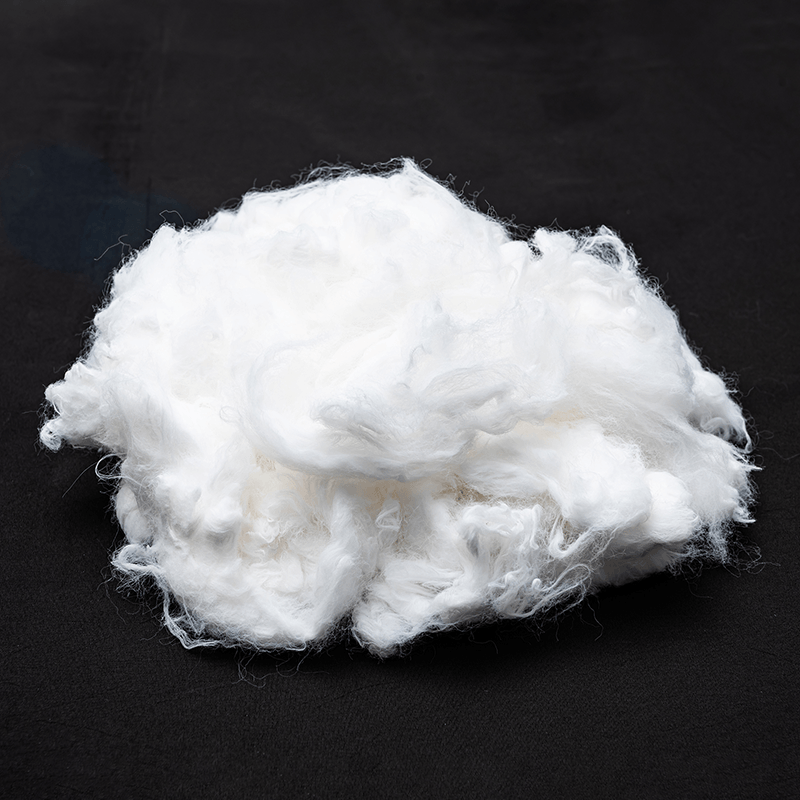
Denier measures the linear mass density of the material. It dictates the thickness of individual strands. Standard ranges vary widely based on application. Fine apparel applications often require 1.2D to 3.0D. Industrial or carpet applications demand thicker strands, ranging from 6D up to 15D. You must match the cut length perfectly to your facility’s spinning system. Cotton spinning systems utilize short staple lengths. You should source 38mm cuts for these setups. Worsted or wool blending systems require longer fibers. You should source 51mm, 76mm, or longer cuts for those lines. Feeding long cuts into a short-staple ring spinner causes massive mechanical jams.
Tenacity measures the ultimate breaking strength. We express it in grams per denier (g/den). High-tenacity requirements demand strict acceptable metrics. For robust industrial applications, establish a baseline above 6.0 g/den. Standard apparel blends might only require 4.0 g/den. Elongation measures how much a strand stretches before snapping. Elongation percentage directly impacts yarn elasticity. Low elongation causes brittle yarns. Brittle yarns suffer frequent breakages during weaving. High elongation creates overly stretchy yarns. These cause baggy, misshapen fabrics. You must specify an elongation range tailored to your final fabric requirements.
Synthetic filaments emerge from the spinneret perfectly straight. Manufacturers must mechanically induce a zigzag wave into the strands. We call this process crimping. Mechanical crimp provides essential friction. This friction ensures fiber cohesion during the drafting and blending phases. Smooth strands simply slide apart. Luster dictates how the material reflects light. Manufacturers control luster by adding titanium dioxide (TiO2) during polymerization. Bright profiles contain minimal TiO2. Semi-dull and full-dull profiles contain higher concentrations. Your choice of luster drastically alters the visual aesthetic of the finished garment.
Even perfectly specified materials can fail during physical processing. You must anticipate mechanical and chemical challenges on the factory floor. Proactive evaluation prevents catastrophic production halts.
Static electricity buildup plagues synthetic textile processing. Carding cylinders rotate at immense speeds. The resulting friction generates massive static charges. Unchecked static causes individual strands to repel one another. The web breaks down entirely, wrapping around machine rollers. You must evaluate the spin finish applied by the supplier. Spin finish is a proprietary chemical oil coating. A high-quality finish lubricates the material and neutralizes static charge effectively. Always test a small batch to ensure the oil content matches your humidity conditions.
Dyeing consistency presents another severe implementation risk. You might encounter "streaky" dyeing, often called barré. This defect ruins entire production runs. It stems from inconsistent crystalline structures across different material batches. If a supplier fails to maintain stable drawing temperatures, the polymer crystallizes unevenly. Uneven crystals absorb dye at different rates. You must demand thermal history logs and strict lot-tracking documentation to prevent streaky garments.
Blending synthetics alongside natural options like cotton or wool creates mechanical challenges. Natural materials exhibit inherent length variations. Synthetics are precisely uniform. Mismatched lengths lead to severe structural weaknesses in the yarn. The drafting rollers might grip the long synthetics while dropping the short natural strands. This creates "drafting waves." You must calibrate your roller settings meticulously. Furthermore, you must ensure your purchased cut length mirrors the average staple length of your natural blending partner.
Finding a supplier involves more than comparing price tags. You need a reliable manufacturing partner capable of scaling alongside your business. An evidence-based vetting framework removes emotional bias from procurement.
You must first evaluate capacity and lead times. A supplier might excel at producing a perfect 10kg sample. However, can they deliver 20 tons on a tight schedule? Assess their actual installed capacity. Ask about their extrusion line output. Verify their ability to handle both initial pilot runs and full-scale commercial rollouts without extending lead times unacceptably.
Robust Quality Assurance (QA) separates elite suppliers from mediocre ones. Look for partners providing comprehensive Technical Data Sheets (TDS) upfront. The TDS should detail tenacity, elongation, crimp frequency, and spin finish percentages. More importantly, demand batch-specific Certificates of Analysis (COA) with every shipment. A COA proves the supplier actively tested the exact lot sitting on your loading dock.
Compliance and certifications validate ethical and chemical standards. REACH compliance is mandatory for accessing European markets. It ensures the material contains no banned toxic chemicals. OEKO-TEX Standard 100 certification guarantees the textile is safe for human contact. If you source recycled variants, you must verify the Global Recycled Standard (GRS). The GRS audits the entire supply chain, ensuring traceability from waste collection to final extrusion.
Follow this recommended shortlisting logic to systematically qualify vendors:
Request the TDS: Compare their documented specifications against your machine requirements.
Request a Sample: Obtain a 5-10kg sample for initial laboratory analysis.
Run a Pilot Spinning Test: Process the sample through your carding and drawing frames to check static and cohesion.
Negotiate Terms: Only after a successful pilot should you negotiate Minimum Order Quantities (MOQ) and Service Level Agreements (SLAs).
Sourcing premium Nylon Staple Fiber demands rigorous attention to detail. You must align chemical properties like dye affinity directly with your aesthetic goals. You must also match physical dimensions perfectly to your facility’s mechanical constraints. Ignoring cut length or crimp profiles leads to inevitable machine jams and wasted capital.
Your next steps are clear. Audit your current spinning line requirements immediately. Document your exact denier, length, and tenacity needs before initiating any new RFQs. Force prospective partners to prove their consistency. Demand transparent batch testing data and comprehensive COAs. By enforcing these strict technical standards, you will build a resilient supply chain and manufacture superior textiles.
A: Industry averages for custom specifications typically range between 1 to 5 metric tons. However, reliable suppliers often allow smaller pilot testing allowances. You can usually negotiate a 500kg trial run to validate spin finish and crimp retention before committing to a full commercial contract.
A: Spin finish acts as a crucial chemical lubricant. It drastically reduces metal-to-fiber friction during high-speed carding and spinning. Most importantly, it neutralizes static electricity. Without proper spin finish, fibers repel each other, destroying web formation and jamming machinery.
A: It depends on the application. Recycled variants perform excellently in standard apparel. However, the depolymerization process can slightly reduce molecular chain length. For extreme high-stress applications like airbags or industrial webbing, you may need virgin fiber to hit peak tenacity metrics.
A: Dyeability differences stem from inconsistent crystalline structures. If a manufacturer fails to control thermal history or draw ratios precisely during extrusion, the polymer crystallizes unevenly. These varying crystal densities absorb dye at different rates, causing visible streaks in the final fabric.


