
English 
No. 21, Xingyuan Road, Jiefang Village, Gushan Town, Jiangyin City
Views: 0 Author: Site Editor Publish Time: 2026-08-08 Origin: Site


Selecting the right synthetic polymer for textile and non-woven manufacturing demands rigorous material evaluation. You must constantly balance raw material costs against strict performance tolerances. These tolerances typically demand high abrasion resistance, superior tensile strength, and reliable thermal stability.
While nylon remains ubiquitous across modern industries, choosing its exact form dictates your operational success. Specifying continuous filament versus staple lengths fundamentally alters how the material behaves. This decision impacts end products in both heavy-duty woven fabrics and pressed or needle-punched felts.
This comprehensive guide provides procurement managers and product engineers with a robust technical framework. We will help you evaluate and specify exact nylon materials to minimize implementation risks. By following these steps, you can rapidly accelerate your supplier shortlisting process and confidently move toward production.
Application Versatility: Nylon fiber’s high strength-to-weight ratio and elasticity make it foundational for both high-stress woven fabrics (tactical, industrial) and non-woven felts (filtration, acoustics).
Form Factor Matters: Specifying nylon staple fiber is critical for non-woven felt applications requiring blending, mechanical interlocking, and consistent density.
Cost vs. Performance: Evaluating Nylon 6 against Nylon 6,6 prevents over-engineering while ensuring necessary thermal and chemical resistance.
Supplier Due Diligence: Reliable sourcing relies on verifying batch-to-batch consistency, compliance certifications (e.g., OEKO-TEX, REACH), and realistic lead times.
Engineers consistently choose synthetic polymers over natural alternatives for demanding industrial environments. The upfront price of these synthetics often exceeds standard polyesters. However, the operational benefits justify the initial investment. You must evaluate the complete lifecycle value.
Durability directly drives procurement decisions. Nylon delivers exceptional fatigue resistance. It withstands millions of bending cycles before structural failure occurs. This resilience dramatically extends the lifespan of the end product. Consequently, end-users replace components far less frequently. This longevity creates substantial lifecycle savings compared to natural fibers or lower-grade polyesters. Reduced replacement cycles mean fewer production downtimes for your clients. Over time, these operational savings heavily outweigh the initial raw material premium.
Procurement teams must verify specific physical properties before signing contracts. You should request detailed specification sheets from your suppliers. Look for these core metrics:
Specific Gravity: It typically sits around 1.14. This provides a lightweight profile while maintaining high density.
Moisture Regain: Rates usually range between 4.0% and 4.5%. This percentage prevents excessive water absorption in damp environments.
Elasticity: The polymer offers excellent stretch-and-return capabilities. It recovers its original shape rapidly after load removal.
Melting Point Thresholds: Thermal stability varies by grade. Nylon 6 melts near 220°C. Meanwhile, Nylon 6,6 withstands temperatures up to 260°C.
You do not need to overhaul your entire production floor. These fibers integrate seamlessly into existing weaving looms. They also run smoothly on standard needle-punching lines. Manufacturers experience minimal equipment retrofitting. You might only need slight tension adjustments on your machinery. This high compatibility ensures you can transition between materials without suffering prolonged operational downtime.
Different industries demand vastly different mechanical properties from their textiles. You must match the material feature directly to the desired outcome. This ensures optimal performance in the field.
Military applications tolerate zero margin for error. Gear must survive extreme physical abuse.
Feature: Exceptional tear strength and elite abrasion resistance.
Outcome: The fabric easily meets strict MIL-SPEC requirements. It forms the backbone of ballistic vests, parachutes, and load-bearing equipment. It achieves this durability without adding excessive, exhausting weight to the soldier.
Industrial settings expose textiles to constant heavy loads. Safety depends on reliable flex fatigue resistance.
Feature: High load-bearing capacity and robust resistance to flex fatigue.
Outcome: It ensures absolute safety and impressive longevity. Manufacturers rely on it for automotive seatbelts. They also use it extensively in heavy-duty cargo straps and commercial netting systems.
Consumer apparel requires both aesthetic appeal and physical comfort. Activewear experiences intense daily stretching.
Feature: Superior dye affinity and excellent moisture management capabilities.
Outcome: Designers can create vibrant, color-fast consumer products. The material provides high structural recovery. It maintains its shape perfectly through repeated wash cycles and rigorous workouts.
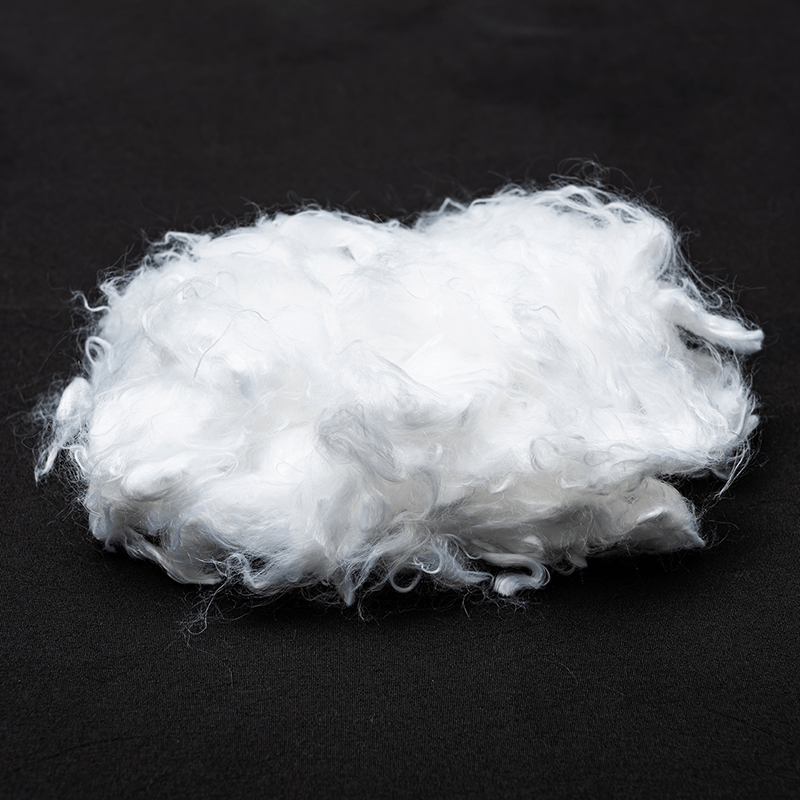
Felt production requires a completely different material geometry than woven fabrics. You cannot feed continuous filament into a needle-punch machine. Instead, manufacturers must cut continuous filaments into standardized short lengths. We call this form staple fiber. This specific geometry is absolutely non-negotiable. Short lengths allow barbed needles to grab and entangle the material. This aggressive mechanical interlocking creates dense, unified pressed felt.
Processing plants push harsh fluids and gasses through filters continuously. These filters face severe chemical attacks daily.
Feature: High resistance to alkalis and specific organic solvents.
Outcome: The felt delivers highly reliable particulate separation. It functions perfectly in fluid and air processing environments. The filter media does not degrade quickly under severe chemical stress.
Heavy machinery and automobiles generate massive amounts of noise. Engineers use thick felts to absorb these disruptive sound waves.
Feature: Exceptional high resilience and rapid compression recovery.
Outcome: The material provides long-lasting structural integrity. It serves as an ideal NVH (Noise, Vibration, and Harshness) control component. It consistently absorbs engine vibrations in automotive and heavy machinery sectors.
Metalworking and glass finishing require intense friction. Standard materials burn or melt during these abrasive processes.
Feature: Uniform fiber distribution and exceptional thermal stability.
Outcome: The felt pad ensures consistent wear rates. It actively prevents material melting during high-friction finishing processes. Workers achieve flawless finishes on delicate glass and tough metal surfaces.
You cannot simply order generic materials and expect premium results. Procurement requires precise specification. You must choose between different molecular structures. You also need to define physical dimensions for your order.
These two variants dominate the market. They share similar traits but behave differently under extreme stress. Nylon 6 offers better dyeability. It features a lower melting point, which benefits specific thermal molding processes. Conversely, Nylon 6,6 provides superior thermal stability. It offers greater stiffness and handles harsh chemical environments much better.
Performance Metric | Nylon 6 | Nylon 6,6 |
|---|---|---|
Melting Point | Approx. 220°C | Approx. 260°C |
Dye Affinity | Excellent (Vibrant Colors) | Moderate (Requires specialized dyes) |
Structural Stiffness | High flexibility and soft hand-feel | Superior rigidity and shape retention |
Chemical Resistance | Good general resistance | Outstanding resistance to synthetic solvents |
You must carefully match fiber thickness to your end application. We measure this thickness in denier. High-denier fibers create coarse, rigid structures. Low-denier fibers yield soft, highly dense filtration media. Cut length also matters immensely. Shorter cuts increase density in needle-punched felts. Longer cuts improve tensile strength in spun yarns. Always match these physical dimensions to the specific porosity requirements of your target fabric.
Many manufacturers do not use 100% synthetic compositions. Instead, they blend different materials to optimize performance. You can blend synthetics alongside natural wool to reduce raw material costs. Blending with aramids drastically increases fire resistance. Mixing it into polyester bases improves overall abrasion resistance. You should evaluate different blend ratios carefully. Prototyping these blends helps you achieve target specifications without overspending.
Sourcing raw materials involves significant corporate risk. You must navigate environmental regulations carefully. Furthermore, you need to protect your supply chain from sudden global disruptions.
Corporate sustainability goals shape modern procurement. Consumer demand for eco-friendly products continues to rise sharply. Transitioning to recycled variants offers a commercial advantage. You can source materials derived from pre-consumer factory waste. Alternatively, you can utilize polymers recovered from ocean plastics. These sustainable choices satisfy ESG (Environmental, Social, and Governance) mandates. They also open doors to lucrative green-certified markets.
Do not assume all materials meet regional safety standards. You must verify compliance before importing bulk orders. Develop strict shortlisting criteria based on industry certifications. Look for OEKO-TEX Standard 100 to ensure zero harmful toxicity in consumer apparel. European buyers must demand strict REACH compliance. If you handle US defense contracts, strictly enforce the Berry Amendment. This law mandates domestic sourcing for specific military textiles.
Synthetic polymers rely heavily on petroleum bases. Therefore, global crude oil fluctuations directly impact your material costs. You must assess these raw material price risks quarterly. Additionally, monitor the geographic concentration of extrusion facilities. Relying on a single overseas region exposes you to severe shipping delays. Diversify your supplier base to mitigate these critical logistical vulnerabilities.
Finding a supplier involves much more than comparing quotes. The cheapest option often introduces severe quality risks. You need a systematic approach to vendor selection.
Look well beyond the sticker price. Focus intensely on their internal Quality Assurance (QA) protocols. Ask how they guarantee lot-to-lot consistency. Inconsistent batches will ruin your felt density or fabric weave. Demand total testing transparency. Reliable suppliers will gladly share their internal audit reports. They should welcome third-party inspections.
Supplier production limits must align with your actual business needs. High MOQs can cripple your prototyping phases. Conversely, low-capacity suppliers will bottleneck your full-scale rollout. Have a frank conversation about volume scaling. Ensure they can support small trial runs today. Verify they can deliver massive freight containers tomorrow.
Never commit to an annual contract based on a digital brochure. You must validate the material physically. Follow these numbered steps to ensure success:
Request detailed Technical Data Sheets (TDS) for the specific grade.
Obtain the Material Safety Data Sheets (MSDS) to verify factory compliance.
Order small physical sample batches of the exact denier and cut length.
Run rigorous in-house mechanical testing on your actual equipment.
Analyze the final prototype for stretch, abrasion, and thermal stability.
Your manufacturing success depends entirely on precise material selection. You must match the exact nylon variant to your specific operational stresses. Choosing between Grade 6 and 6,6 dictates your thermal thresholds. Specifying continuous filament versus staple lengths determines your manufacturing methodology. By applying this evaluation framework, you eliminate guesswork. You protect your supply chain from quality inconsistencies and compliance failures.
Take immediate action to secure your production lines. Contact a specialized material engineering representative today. Request a custom consultation to discuss your specific fabric or felt project. Order a comprehensive sample kit immediately. Test these samples on your equipment to validate their performance.
A: Continuous filament consists of an unbroken, endlessly extruded synthetic strand. Manufacturers use it primarily for weaving strong, smooth, high-tension fabrics. Staple fiber is that same continuous strand chopped into standardized, short pieces. Manufacturers use these short pieces primarily for spinning yarn or creating mechanically interlocked non-woven felts.
A: Yes, it blends exceptionally well with natural wool. The short staple lengths perfectly match the dimensions of wool fibers. This compatibility aids aggressive mechanical interlocking during the needle-punching process. Blending increases the felt's overall abrasion resistance while maintaining wool's natural acoustic dampening properties.
A: Temperature limits depend on the specific grade used. Nylon 6 generally melts around 220°C (428°F). Nylon 6,6 offers higher thermal stability, melting near 260°C (500°F). For continuous, long-term industrial operations, you should keep ambient temperatures well below these absolute melting points to prevent structural deformation.
A: Recycled variants maintain impressive tensile strength. Advanced chemical recycling processes break down waste to a molecular level before re-extrusion. This modern process yields performance metrics nearly identical to virgin polymers. However, cheaper mechanical recycling can cause minor strength degradation. Always request technical data sheets to verify exact strength limits.


